The agronomist's notebook: piling
The agronomist's notebook: piling
Share on:
Share on:
A few months have passed since the planting of our Trebbiano Spoletino cuttings, and now it's time to give shape to our vineyard. This time, I do the agronomy lesson myself, limiting myself only to describing what has been done and used for our Trebbiano Spoletino.
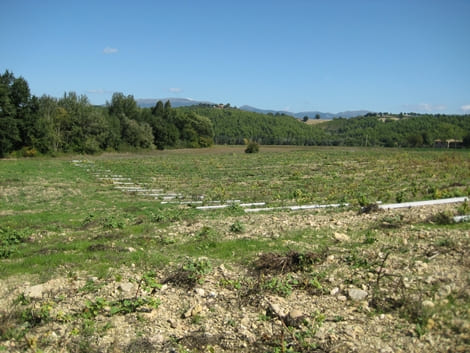
The second phase, necessary for the construction of a vineyard, consists of piling, that is the insertion of steel poles called "inter-row" and prestressed concrete poles called "capotesta". The former, which are arranged along the rows at regular intervals, only have the function of supporting the steel wires, while the latter, which are positioned only at the ends of each row, have the function of resisting the tension impressed on the wires themselves.
Here are some main features of the steel poles used in our Trebbiano Spoletino vineyard:
- manufacturer: Profil Alsace sas
- model: P4N pole
- material: galvanized steel
- width: 45 mm
- thickness: 30 mm
- length: 240 cm
- driving depth: approx. 65 cm
Let's now see how our operators Mauro and Gabriele performed the arrangement and driving of the steel poles.
First of all, Gabriele prepared a wooden rod with a length equal to the distance that must exist between one inter-row pole and the other (5.00 meters), also reporting on it the distance between one row and another. (2.80 mt) by engraving a notch. In this way, the piling was speeded up by avoiding taking measurements with tapes every time you have to plant a pole. Also in this case, as happens for the planting of the cuttings, a new squaring must be performed and it is in this phase that it is seen if the previous one has been made correctly. Well, it must be said that the phase shift between one square and the other was a few centimeters, so considering the extreme precision of Gabriele, who used a laser level as a measuring instrument, we can be satisfied with the previous work, good Renzo!
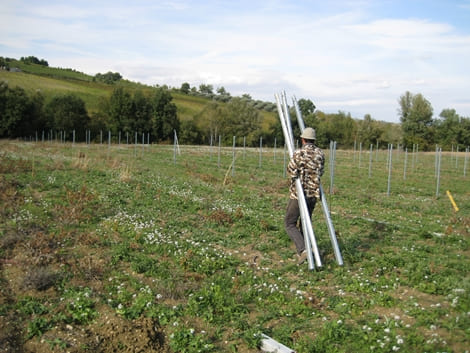
The next phase was the manual positioning of the poles, near the points on which they were actually fixed. Therefore, while Gabriele marked the depth of insertion with a felt-tip pen on each pole, Mauro arranged the already marked poles along the rows of Trebbiano Spoletino.
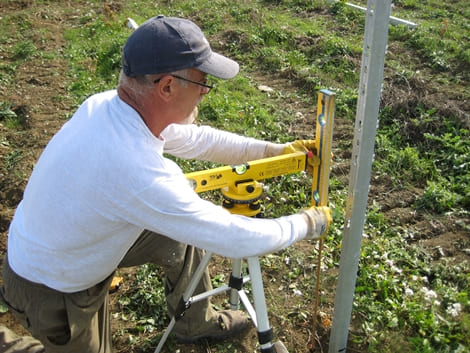
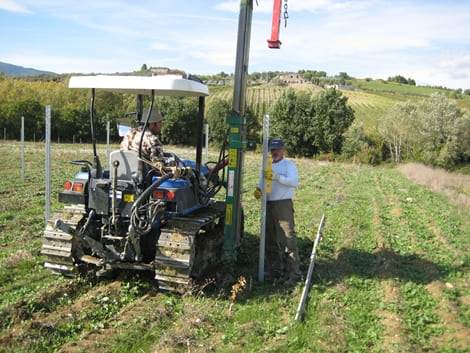
The last phase, the most delicate, was the actual driving of the steel poles using a tool that takes the name of "post driver", which was hooked by Mauro laterally to the crawler. For each drive, while Gabriele marked the exact point where the pole was to be driven with the wooden rod, Mauro advanced with the crawler moving the head of the post driver vertically to the same point. Subsequently, while Gabriele was holding the pole to be inflicted, it gradually entered the ground due to the pressure exerted by the head of the post driver on the upper end of the pole itself. During and after the insertion, Gabriele equipped with a spirit level checked the exact verticality of the pole, which in the negative case he manually bent the pole by rectifying it.
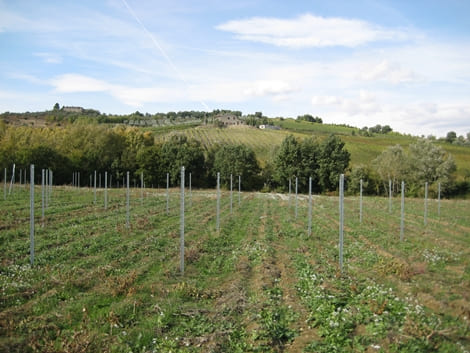
And now that the vineyard has taken its shape, let's think about the farming method of our Trebbiano Spoletino vineyard ...
A few months have passed since the planting of our Trebbiano Spoletino cuttings, and now it's time to give shape to our vineyard. This time, I do the agronomy lesson myself, limiting myself only to describing what has been done and used for our Trebbiano Spoletino.
The second phase, necessary for the construction of a vineyard, consists of piling, that is the insertion of steel poles called "inter-row" and prestressed concrete poles called "capotesta". The former, which are arranged along the rows at regular intervals, only have the function of supporting the steel wires, while the latter, which are positioned only at the ends of each row, have the function of resisting the tension impressed on the wires themselves.
Here are some main features of the steel poles used in our Trebbiano Spoletino vineyard:
- manufacturer: Profil Alsace sas
- model: P4N pole
- material: galvanized steel
- width: 45 mm
- thickness: 30 mm
- length: 240 cm
- driving depth: approx. 65 cm
Let's now see how our operators Mauro and Gabriele performed the arrangement and driving of the steel poles.
First of all, Gabriele prepared a wooden rod with a length equal to the distance that must exist between one inter-row pole and the other (5.00 meters), also reporting on it the distance between one row and another. (2.80 mt) by engraving a notch. In this way, the piling was speeded up by avoiding taking measurements with tapes every time you have to plant a pole. Also in this case, as happens for the planting of the cuttings, a new squaring must be performed and it is in this phase that it is seen if the previous one has been made correctly. Well, it must be said that the phase shift between one square and the other was a few centimeters, so considering the extreme precision of Gabriele, who used a laser level as a measuring instrument, we can be satisfied with the previous work, good Renzo!
The next phase was the manual positioning of the poles, near the points on which they were actually fixed. Therefore, while Gabriele marked the depth of insertion with a felt-tip pen on each pole, Mauro arranged the already marked poles along the rows of Trebbiano Spoletino.
The last phase, the most delicate, was the actual driving of the steel poles using a tool that takes the name of "post driver", which was hooked by Mauro laterally to the crawler. For each drive, while Gabriele marked the exact point where the pole was to be driven with the wooden rod, Mauro advanced with the crawler moving the head of the post driver vertically to the same point. Subsequently, while Gabriele was holding the pole to be inflicted, it gradually entered the ground due to the pressure exerted by the head of the post driver on the upper end of the pole itself. During and after the insertion, Gabriele equipped with a spirit level checked the exact verticality of the pole, which in the negative case he manually bent the pole by rectifying it.
And now that the vineyard has taken its shape, let's think about the farming method of our Trebbiano Spoletino vineyard ...